The Visibility Gap
Most vulnerability programs rely on scanning known assets and ranking findings based on static severity scores. That model breaks down quickly in modern environments. Asset lists are constantly changing, devices move between networks, workloads shift into cloud platforms, and unmanaged systems appear outside traditional inventory controls. When asset visibility is incomplete, vulnerability data is incomplete as well.
The result is predictable. Prioritization becomes inconsistent. High-impact vulnerabilities on critical systems are missed or delayed. Lower-priority issues consume time because they are easier to find and track. Remediation workflows stretch across multiple tools and take longer than expected.
Aurora® Vulnerability Management approaches this differently. It treats asset visibility and vulnerability management as a single operational problem. Instead of relying on a list of vulnerabilities, it leverages an up-to-date view of your assets and their associated vulnerabilities.
That change in perspective is what allows teams to move from reactive activity to security outcomes.
How Aurora Vulnerability Management Brings Assets and Risk Together
Aurora Vulnerability Management is built to give security teams an operational view of their environment. It connects asset discovery, risk context, and remediation into one workflow so teams can act quickly and consistently.
Assets in Context
Aurora Vulnerability Management aggregates data from multiple sources to build a more accurate picture of what exists in the environment. Assets can be discovered through agents, directory services, and network activity, which helps surface systems that may not appear in a single tool.
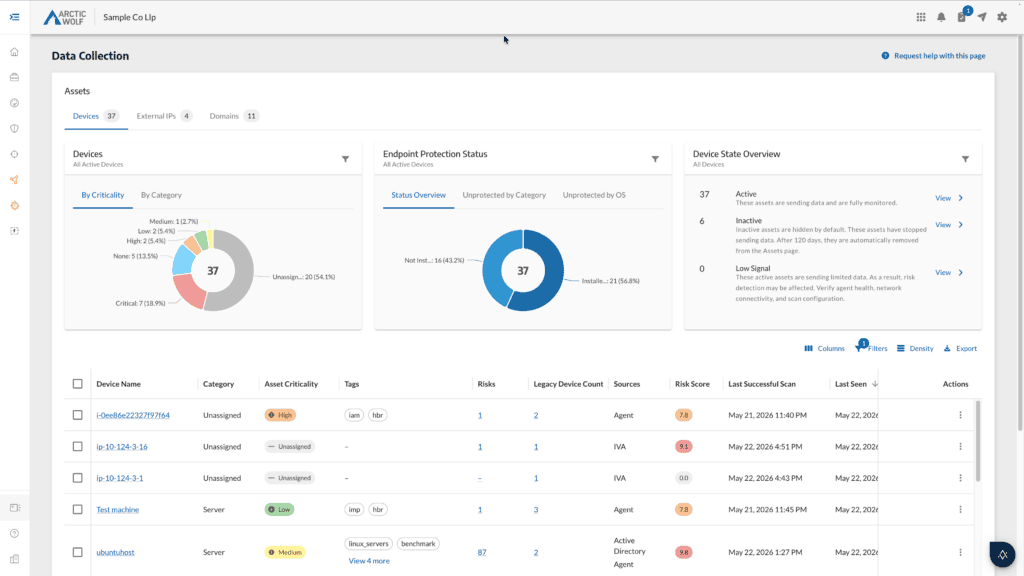
Within the platform, the asset view provides more than a list. It includes helpful attributes including asset category, business criticality, custom tagging, and a normalized risk score unique to your organization’s context. This allows teams to immediately understand not just what an asset is, but how important it is in the context of the organization.
This matters because effective prioritization relies on context. A vulnerability on a low-impact system is not the same as a vulnerability on a production server. By combining asset context with vulnerability data, Aurora Vulnerability Management makes that distinction clear from the start.
The interface also supports filtering and grouping based on these attributes. Security teams can isolate high-risk assets, focus on specific categories such as servers, or build views that match their internal ownership model.
This removes the need to manually correlate data between tools and can reduce the time required to identify where attention is needed.
Linking Assets and Vulnerabilities
One of the most practical capabilities in Aurora Vulnerability Management is the ability to pivot directly from an asset to its associated risks.
From the asset view, selecting a system reveals a detailed profile that includes installed software, discovered vulnerabilities, and overall risk exposure. Each vulnerability can be sorted and grouped based on score, type, or remediation path.
This simplifies investigation. Instead of moving between inventory tools and vulnerability scanners, teams can analyze exposure at the system level in one place.
The same workflow can be used in reverse. When an incident occurs, such as suspicious activity flagged by detection tools (e.g. EDR, XDR, IDS), security teams can quickly locate the associated asset and evaluate its vulnerability posture. This connection between detection and exposure helps teams understand not only what happened, but why the system may have been susceptible.
This linkage is critical for reducing investigation time and improving response decisions.
Prioritization of Asset Risk
Aurora Vulnerability Management does not stop at visibility. It makes prioritization practical by combining vulnerability severity with asset context.
Each asset is assigned a risk score that reflects its overall exposure profile. Security teams can filter based on that score to focus on the highest-risk systems first. For example, filtering for assets with scores between 8 and 10 immediately highlights the most critical systems in the environment.
This approach avoids the common issue of treating all high-severity vulnerabilities equally. Instead, it focuses attention on systems where risk is concentrated.
Filtering can be refined further using asset attributes such as tags or categories. This allows teams to align prioritization with organizational structure, ownership, or operational boundaries.
These views can also be saved and reused, which creates consistency across investigations and remediation cycles. Over time, this can reduce variability in how teams approach prioritization.
Integrated Remediation Capabilities
Once priorities are clear, the next challenge is execution. Aurora Vulnerability Management keeps remediation within the same workflow.
From the risk view, teams can access detailed information about each vulnerability, including timelines and AI-driven remediation guidance. This helps remove guesswork and accelerate decision making.
Actions can be taken directly from the platform. Organizations can create ITSM tickets to track remediation or apply patches using the Resolve patching capability. Patches can be deployed immediately or scheduled, depending on operational requirements.
This is designed to reduce the need to switch between tools and minimizes delays between identification and remediation.
Tracking is built into the same process. Risks can be assigned to specific teams, given due dates, and updated as work progresses. This creates accountability while keeping visibility centralized.
Discovery to Validation
Closing a vulnerability ticket does not always mean the issue is resolved. Aurora Vulnerability Management includes mechanisms to verify that remediation actions were effective.
Assets can be rescanned, and risk states are updated based on current data. This helps validate remediation actions and indicate whether exposure may have been reduced.
Over time, this creates a measurable view of progress. Security teams can see how risk scores change and track improvements across the environment. Reporting supports this by providing summaries that can be shared with stakeholders who need to understand overall risk posture.
This closed-loop model is what turns vulnerability management into a continuous process rather than a series of disconnected tasks.
Aligning Asset Visibility With Risk Reduction
Vulnerability management works when it reflects how environments actually operate. That means understanding assets as they exist today, not as they were last scanned. It means prioritizing based on real impact, not just severity scores. And it means ensuring that remediation actions lead to measurable improvements.
Aurora Vulnerability Management brings these elements together in a single workflow. By linking asset visibility with vulnerability data and remediation actions, it gives security teams a clear path from discovery to resolution.
For organizations looking to reduce exposure instead of just tracking it, this approach changes how work gets done.
To see how asset-centric vulnerability management works in practice, watch the demo: