
The Problem With Vulnerability Management
Security teams are not struggling to find vulnerabilities. They are struggling to deal with them in a way that actually reduces risk.
Most environments generate thousands of new findings every month. While vulnerability scanners, cloud tools, and endpoint platforms all contribute, that data does not come together in a way that is actionable. Teams end up with long lists of vulnerabilities, limited context, and no clear way to determine what should be fixed first.
At the same time, attack surfaces continue to expand. Assets extend beyond endpoints and servers to include cloud environments, SaaS platforms, and external infrastructure. Many of those assets are unmanaged or unknown, which creates blind spots that traditional scanning cannot fully address. Security teams are often forced to make decisions based on incomplete or outdated inventory data, which undermines prioritization from the start.
The result is a reactive operating model. Analysts spend time chasing medium-severity findings while higher-risk exposures remain open. Remediation workflows span multiple tools, require manual coordination, and take too long to execute. Closing a ticket becomes the goal, even though it does not guarantee the underlying risk has been removed.
This gap between vulnerability detection and real risk reduction continues to widen. Exploitation timelines are shrinking. Attackers are moving faster, sometimes exploiting vulnerabilities before organizations even become aware of them.
To keep pace, vulnerability management needs to evolve. It must move from scanning and reporting to something more complete. It must provide full visibility, prioritize based on actual risk, and drive remediation in a way that is measurable.
Aurora® Vulnerability Management is built around that model.
How Aurora Vulnerability Management Delivers Practical Security Outcomes
Aurora Vulnerability Management is designed to simplify how security teams identify, prioritize, and remediate vulnerabilities across their environment. The focus is not just coverage, but operational effectiveness.
Unified Attack Surface Visibility
Aurora Vulnerability Management brings vulnerability data and asset inventory together into a single view. Instead of relying on one scanning method, it aggregates data from multiple sources across endpoints, networks, cloud services, and external exposures.
This matters because vulnerability data only has value when it is tied to a complete understanding of assets. Aurora Vulnerability Management helps organizations build that understanding by identifying both known and unknown devices, including unmanaged assets discovered through sources like DHCP, Active Directory, and network telemetry.
With this broader visibility, teams are no longer working from a partial inventory. They can see what exists, what is exposed, and where protection gaps may exist.
The interface supports filtering, grouping, and sorting based on attributes that matter to the organization. This allows teams to quickly isolate the vulnerabilities that require attention instead of scanning through raw lists.
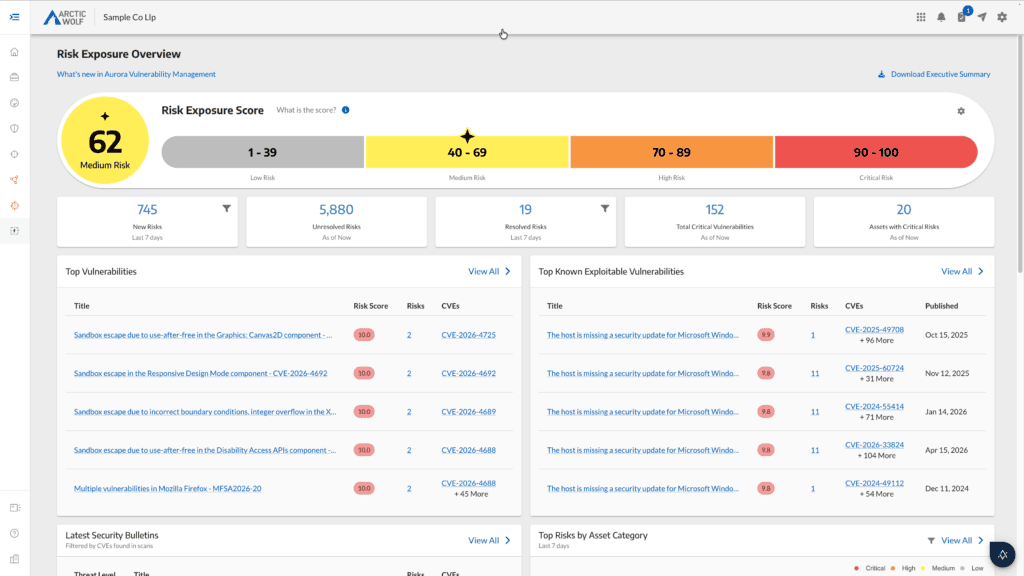
A look at Risk Exposure Score
Prioritization of Real Risk
Traditional vulnerability management relies heavily on static severity scores. That approach does not reflect an organization’s internal context or how attackers actually operate.
Aurora Vulnerability Management takes a different approach. It combines CVE data with threat intelligence, exploit likelihood, asset criticality, and environmental context. This allows security teams to focus on vulnerabilities that are more likely to be exploited with the real potential for business impact.
Security bulletins from the Arctic Wolf Threat Research Team are also readily available for vulnerability context. These provide current insights into threat actor behaviors and link them back to exposures in the customer environment. This makes prioritization more dynamic and aligned with real-world activity, not static scoring alone.
The result is less time spent chasing low-priority findings and more time addressing vulnerabilities that matter.
Closed-Loop Remediation
One of the biggest gaps in vulnerability management is remediation execution. Even when teams know what to fix, remediation often requires jumping between tools, creating tickets manually, and tracking progress across disconnected systems.
Aurora Vulnerability Management brings remediation into the same workflow. Patch management capabilities and integrations with ITSM tools allow organizations to move directly from identification to action. Patching can be executed immediately or scheduled, while remediation workflows can be customized to match organizational processes and SLAs. This reduces manual effort and removes delays that often occur between security and IT teams.
AI-powered remediation guidance adds another layer of efficiency. Instead of forcing analysts to research every vulnerability, the platform provides recommended actions based on context, exploitability, and observed threat activity.
The result is shorter time to remediation and enhanced process consistency.
Verified Risk Reduction
Many vulnerability management programs stop at ticket closure. Aurora Vulnerability Management extends beyond that point to verify risk remediation. Once remediation actions are taken, the platform supports rescanning and validation to confirm that vulnerabilities have been addressed. This creates a closed-loop process where risk reduction can be measured, not assumed.
This is an important distinction. It allows teams to move beyond activity-based metrics and demonstrate real outcomes. Security leaders can track trending improvements over time, using reporting that includes 30-, 60-, and 90-day views of risk posture and remediation performance.
This kind of visibility is critical for communicating progress to stakeholders and aligning security efforts with business impact.
Maximizing Security Operations
Aurora Vulnerability Management is designed as part of the broader Aurora Exposure Management solution. It integrates with Aurora Managed Detection and Response to correlate vulnerability data with real detection activity, and with Aurora Attack Surface Management to provide a single source of truth for exposure across the environment. This creates a stronger feedback loop between proactive and reactive security operations.
When these capabilities are combined, organizations gain more than visibility. They gain a practical way to reduce the likelihood of successful attacks by addressing the exposures attackers are most likely to exploit.
A Simpler Path to Reducing Exposure
Vulnerability management has reached a point where volume alone is no longer the challenge. The real issue is turning that volume into meaningful action.
Aurora Vulnerability Management addresses this by combining visibility, prioritization, and remediation into a single operating model. Security teams can identify what exists, understand what matters, and act on it without switching between tools or relying on manual workflows.
The result is a more effective approach to managing exposure. One that focuses on outcomes instead of activity.
This demo shows Aurora Vulnerability Management in action.