

The scale and severity of cybersecurity activity in October 2026 was unprecedented. Arctic Wolf Aurora Incident Response handled 78% more non-Arctic Wolf customer cases than the average month, and sophisticated network intrusion incidents, including ransomware, for non-Arctic Wolf customers rose by 96%, accounting for nearly all of the growth. Attackers aren’t just more active. They’re more dangerous.
But given how quickly the threat landscape is changing, October being our busiest month on record for our Aurora Incident Response team isn’t an anomaly, but rather the start of a new normal.
With a growing volume of disclosed vulnerabilities and the speed with which attackers are exploiting them, defenders should not expect conditions to become less demanding anytime soon.
As we saw from the PHP2Shell and Java4Shell disclosures that dominated recent headlines, attackers appear to be using AI to research targets, identify vulnerabilities, create phishing lures, and run campaigns at a scale that wasn’t possible just a few months ago. Organizations are also rapidly adopting AI tools, integrations, and services of their own, expanding the attack surface that their adversaries could exploit. Together, these behaviors are contributing to a higher volume of incidents and creating more opportunities for attackers to gain access.
From AI-Enabled Attackers to AI-Enabled Malware
But it’s not just AI adoption, or using AI to develop threat tactics and techniques, that is creating this frictionless environment for attackers. Malware itself is starting to use AI during attacks. Rather than carrying all of its instructions from the start, some malware now includes a lightweight loader that reaches out to an LLM for guidance while it runs. In Arctic Wolf’s malware samples we analyzed, we observed Large Language Model (LLM) API calls during execution, showing that AI is increasingly becoming part of the attack chain itself, not just a tool attackers use beforehand.
Today, these uses are relatively simple. We’ve seen malware use LLMs to generate file names, customize payloads, and create convincing social engineering messages on demand. But the same approach could evolve to support more advanced capabilities, such as adapting to security controls, tailoring attacks to specific victims, or helping attackers navigate an environment after initial access.
That creates a challenge for defenders. Traditional malware detections focus on what’s stored on disk, which means they can miss logic delivered in real time through an AI service. In order to build resilience against these kinds of AI-embedded malware, defenders need to monitor runtime behavior more closely, including unexpected processes making outbound connections to LLM platforms or AI APIs. This requires organizations to have full visibility into their environment.
AI has already changed the threat landscape by making sophisticated attacks easier to pull off. Techniques that once required deep expertise are now within reach for a much wider range of attackers, and those attackers can operate at a faster pace and larger scale than ever before. October’s incident data reflects that shift.
For our non-Arctic Wolf customers, business email compromise (BEC) incidents remained relatively steady, but more complex attacks surged. Ransomware cases rose by 77%, pre-ransomware cases rose by 55% and network intrusion incidents as a whole rose 96%.
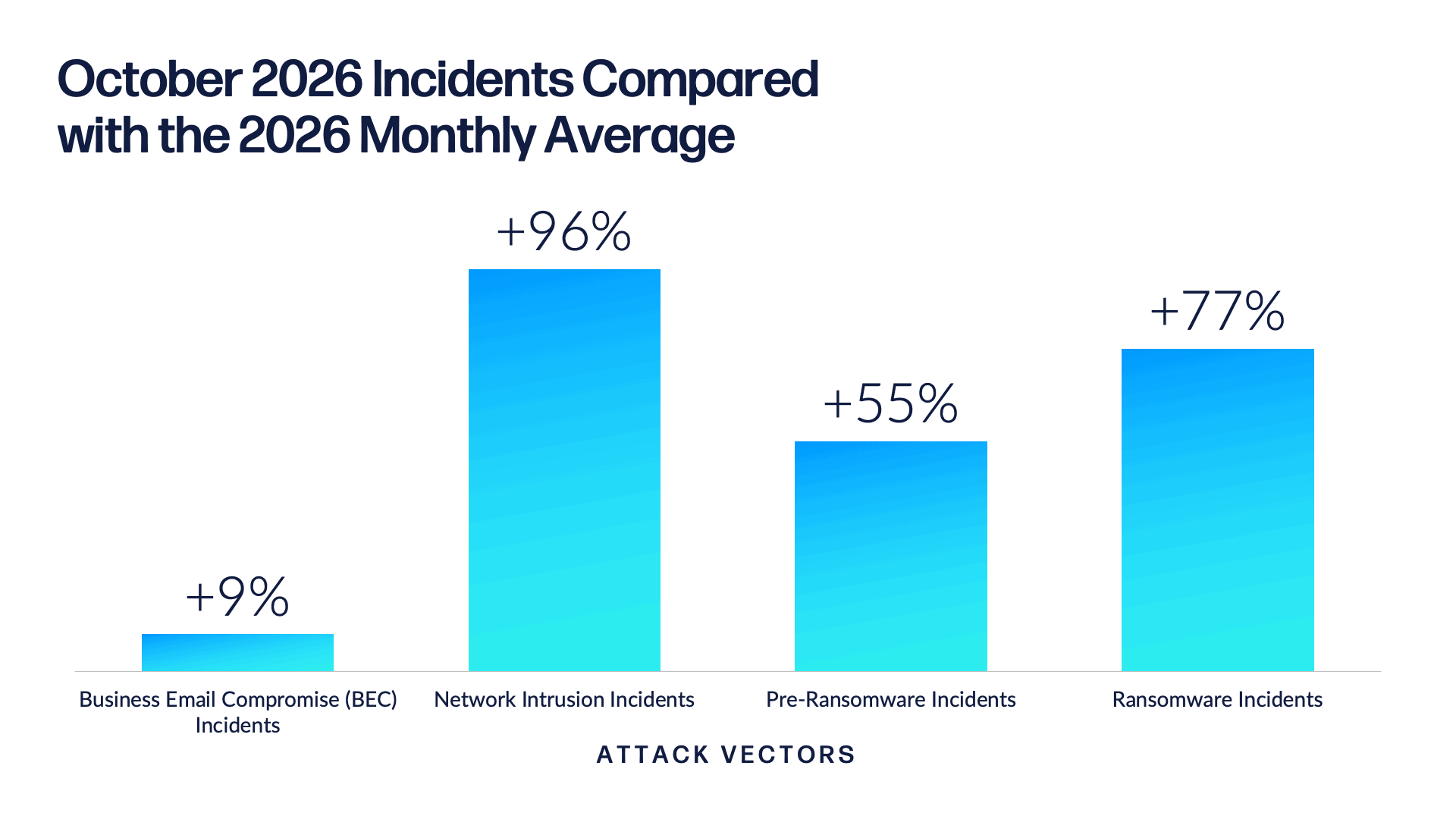
These advances suggest that as more threat actors gain access to advanced capabilities, organizations are facing a growing volume of serious and potentially damaging attacks. Thankfully, we have insight into who these newly resource-enabled attackers are targeting, how they’re tailoring their attack patterns, and which threat groups are the most active.
More Attackers, More Opportunities for Compromised
The attack patterns observed in October reflect the reality that social engineering, external remote access, and exploitation of internet-facing systems were the most common attack vectors in Aurora Incident Response engagements. AI is helping attackers make these techniques more effective. Phishing messages can be personalized in seconds. Reconnaissance that once took days can be completed in minutes. Attackers can scan large portions of the internet for vulnerable systems and quickly focus their efforts on organizations that appear easiest to compromise.
The ransomware groups most frequently observed in October included Akira, Qilin, INC, DragonForce, and Settra.1 Organizations across legal services, manufacturing, real estate, software development, and financial services accounted for the largest share of incident response cases. These industries continue to attract attacker attention because of the sensitive data they manage, the operational disruption they can suffer, and the financial leverage they often present during an attack.
Organizations do not need to slow AI adoption, but they do need to prepare for an environment where attackers can operate at machine speed. Understanding internet-facing assets, maintaining strong identity controls, reducing unnecessary exposure, and regularly testing incident response plans all become more important as the pace of attacks increases.
Cyber resilience depends on knowing how to respond when prevention fails. The organizations that recover fastest are often the ones that prepared before the incident occurred, established clear escalation paths, and practiced how they would respond under pressure.
1 Threat actor attribution reflects Arctic Wolf’s assessment based on October 2026 incident data and may evolve with new evidence. References to threat actor identity are analytical judgments, not statements of legal fact.
This blog reflects my own views as of the publication date and includes forward-looking statements about technology trends. Actual outcomes may differ based on attacker behavior, customer environments, and broader market and regulatory developments.