

Endpoint security has become one of the most difficult layers of the modern security stack to operate effectively. Endpoints sit at the intersection of user behavior, identity compromise, phishing, ransomware, and hands‑on‑keyboard activity. At the same time, attackers increasingly rely on fileless techniques, memory abuse, and legitimate tooling to evade signature‑based defenses.
Most organizations have some type of endpoint protection and likely endpoint detection and response (EDR) tooling. But those solutions come with challenges. Prevention efficacy can vary; detections are often noisy or incomplete, and investigations require context that is not always available to analysts.
Discover why endpoint visibility is critical for endpoint security and IT operations, and how it allows organizations to manage, monitor, and control endpoints.
The result is familiar to most security teams: alerts that outpace triage capacity, inconsistent protection across platforms, and response workflows that vary depending on response team and tool access.
Arctic Wolf’s Aurora® Endpoint Defense addresses these exact issues. Rather than leading with dashboards or alert counts, the solution is designed to deliver outcome‑driven endpoint security. It combines proven prevention, high‑fidelity detection, contextual AI analysis, and flexible response options that work at scale.
How Aurora Endpoint Defense Delivers Effective, Efficient Endpoint Security
Aurora Endpoint Defense is designed to reduce both risk and operational overhead by focusing on three core goals: strong prevention, high signal detection, and efficient response. It delivers proven security outcomes, eliminates noise, and saves your organization both time and resources.
Proven Prevention with Predictive AI
At the foundation, Aurora Endpoint Defense uses a battle-tested, predictive machine-learning model to classify malicious files and prevent them from executing. This model has been battle proven through years of real‑world deployments and has demonstrated consistently high protection rates in independent evaluations. In an evaluation done by the Tolly Group, Aurora Endpoint Security achieved a 99% true-positive rate blocking over 150,000,000 unique strains of malware and an average of 250 malicious files per customer in 2025.
With Aurora Endpoint Defense, endpoints can be protected both online and offline. When malicious files are identified, they are designed to be automatically blocked and quarantined, stopping ransomware and commodity malware before impact. This reduces reliance on downstream detection and containment workflows, which are often more disruptive and costly.
Ease of Deployment and Time to Value
Ease of deployment is a critical requirement for endpoint security to succeed at scale. Aurora Endpoint Defense supports Windows, macOS, and Linux, using a lightweight agent designed to minimize CPU and memory impact.
Installation can be performed manually or through standard software deployment tools, allowing organizations to roll out protection quickly. Once deployed, endpoints remain protected even when disconnected from the network in the case of mobile workforces or air-gapped networks.
This focus on simplicity is intended to reduce time to value and lowers the barrier to consistent endpoint coverage across the environment.
High-Fidelity Detection Built for Investigation
As the threat landscape rapidly evolves, novel attacks are constantly being developed in an effort to evade detection. When suspicious activity occurs, Aurora Endpoint Defense provides EDR capabilities focused on signal quality and reduced alert fatigue.
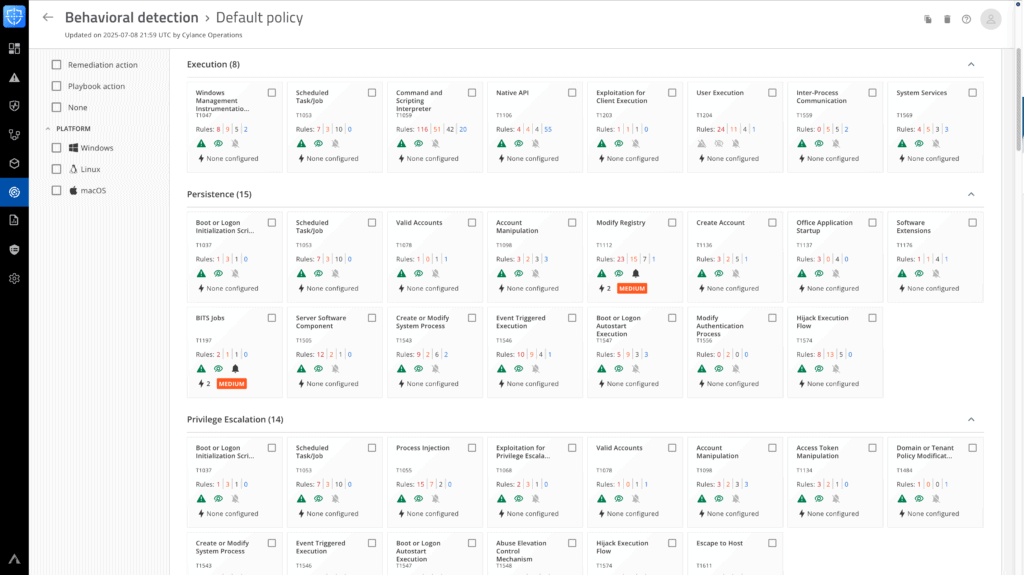
Behavioral detections identify suspicious activity, such as executables appearing in unusual locations or techniques commonly associated with malware and interactive attacks. These detections are mapped to MITRE ATT&CK tactics and techniques, giving analysts immediate context instead of forcing them to reverse engineer alerts.
AI Context Accelerates Response
The alert triage experience is consistent across both prevention and detection events. Alerts can be sorted by severity, status, or technique, making it easier to prioritize investigations without navigating multiple views or tools.
With some solutions, investigations can stall because analysts lack immediate context: what a command does, why it matters, or how it fits into a broader attack chain. Aurora Endpoint Defense addresses this with the Aurora Security Assistant.
The Aurora Security Assistant provides on‑demand analysis that explains attacker objectives, command behavior, and likely intent, along with providing recommended next steps. This context is designed to be delivered at the moment it is needed, reducing investigation time and helping less experienced analysts operate with confidence.

Instead of exporting data to separate tools or documentation, analysts can stay focused on the investigation while gaining clarity on what they are seeing.
Autonomous and Manual Response Options
Endpoint security loses value if response actions are slow or inconsistent. Aurora Endpoint Defense supports autonomous response actions that can be configured by technique, severity, or event type. These responses can be executed automatically or triggered manually during investigations.
This flexibility allows organizations to balance speed and control. High‑confidence detections can be contained immediately, while more ambiguous activity can be reviewed before action is taken. Response capabilities integrate cleanly into endpoint workflows without requiring additional orchestration layers.
Flexible Delivery and Managed Options
Aurora Endpoint Defense supports multiple operational models. Self‑managed deployments allow internal teams to maintain full control, while managed options are available for organizations that require 24×7 monitoring or on‑demand expert support.
This flexibility allows endpoint security to scale with organizational maturity, whether the goal is augmenting an existing SOC or outsourcing endpoint monitoring entirely.
Endpoint Security That Integrates Into the Bigger Picture
Aurora Endpoint Defense does not operate in isolation. It integrates with the broader Aurora Superintelligence Platform, enabling endpoint telemetry to contribute to full attack chain visibility when combined with identity, network, cloud, and email signals.
For security teams, this means endpoint events are no longer investigated in a vacuum. They become part of a correlated narrative that improves accuracy and speeds containment. That is especially impactful for multistage attacks where endpoint activity is only one piece of the puzzle.
See Aurora Endpoint Defense in Action
Endpoint security must do more than generate alerts. It must deliver effective prevention, detect malicious activity with context, and support fast, confident response when necessary.
Aurora Endpoint Defense delivers this by combining proven predictive AI, high‑fidelity behavioral detections, embedded investigation context, and flexible response options through a solution that is easy to deploy and operate.
To see Aurora Endpoint Defense in action from prevention through detection and response, watch the demo video:
You can also experience Aurora Endpoint Defense for yourself by starting your test drive today.