AI-Assisted Detection Engineering
One of the most important shifts AI enables in detection engineering is changing where engineers spend their time. Traditionally, a significant portion of detection development effort is consumed by implementation details: writing complex SQL queries, building enrichment pipelines, handling edge cases, tuning rule logic, writing tests, documenting detections, and repeatedly iterating on detection logic. Those tasks are necessary, but they are also time-consuming. The most critical work is understanding attacker behavior.
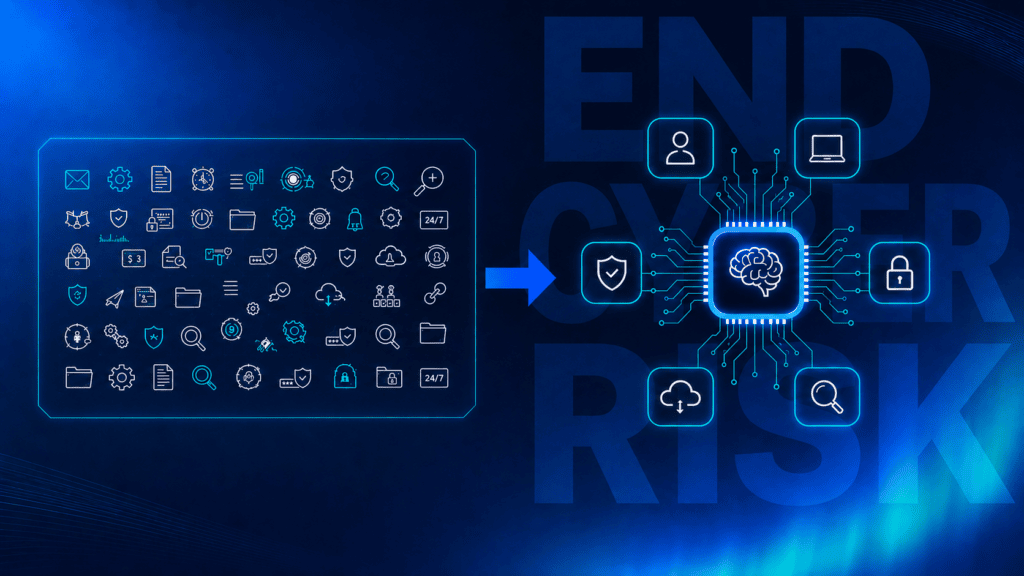
AI agents are improving how Arctic Wolf builds and scales detection engineering by allowing engineers to focus more directly on tactics, techniques, behavioral patterns, and adversary tradecraft rather than the mechanics of implementing detection logic. Rather than relying on a single general-purpose assistant, Arctic Wolf has launched the Aurora® Superintelligence Platform: a coordinated fleet of specialized AI agents, each designed with focused skills that support different stages of the detection lifecycle.
In this model, an agent is an AI-powered system that can reason through a task, use available context, call tools, and produce a useful work product. A “skill” is a specialized capability that helps an agent perform a specific type of work, such as threat research, query authoring, detection development, test generation, documentation, investigation summarization, enrichment analysis, or tuning support.
This creates a more scalable and specialized detection development workflow. A threat research agent might summarize emerging attacker behavior and map it to relevant tactics, techniques, and procedures (TTPs). A query authoring agent might translate that behavior into efficient SQL across large-scale telemetry. A detection development agent might help turn the query logic into stateless or stateful detection code. A validation agent might generate test cases, identify edge cases, and help evaluate detection quality before deployment. Other agents may assist with documentation, enrichment strategy, analyst feedback review, or investigation summarization based on real telemetry.
Instead of spending hours translating an investigative idea into production-ready detection logic, engineers can focus on identifying meaningful attacker behaviors and defining the detection intent. AI agents then accelerate the implementation of the underlying logic: generating and optimizing SQL queries, building correlation logic, validating detection coverage, producing test cases, documenting detections, and refining detection behavior based on telemetry and analyst feedback.
This fundamentally changes the detection development lifecycle. Detection engineers remain responsible for the work that requires human judgment: understanding adversary behavior, deciding which signals matter, validating detection quality, and ensuring the final logic aligns with the intended security outcome. AI agents handle much of the repetitive and implementation-heavy work required to operationalize those ideas at scale.
The result is not simply faster development. It is a shift toward more adaptive and intelligence-driven detection engineering. Prioritizing performance outcomes can help teams iterate more quickly as attacker behavior evolves, supports faster operationalization of new threat intelligence, and maintains greater consistency across large portfolios of detections. Combined with platform-scale telemetry and investigation data, an agent-driven detection engineering workflow enables defenders to transform insights learned from thousands of investigations into production-ready detections far more rapidly than traditional development approaches allow.
What Changes in the Detection Lifecycle
- From manual query and rule crafting to AI-accelerated logic generation and optimization
- From ad hoc documentation and tests to auto-generated specs, test fixtures, and validation harnesses
- From isolated rules to correlated, stateful, and behavior-aware analytics
- From periodic tuning to continuous, feedback-driven refinement using analyst outcomes
- From slow time-to-production to rapid operationalization in streaming pipelines
Example AI-Assisted Tasks
- Generate SQL for multi-surface telemetry queries and identify performance optimizations
- Transform investigative hypotheses into candidate detection logic with baseline correlation
- Synthesize unit tests and replay datasets from historical incidents
- Map detection logic to techniques and behaviors (e.g., MITRE ATT&CK®)
- Summarize analyst notes into detection documentation and tuning guidance
- Propose enrichment strategies (e.g., identity, IP/ASN, geolocation, reputation)
Composite Detections and Behavioral Analytics
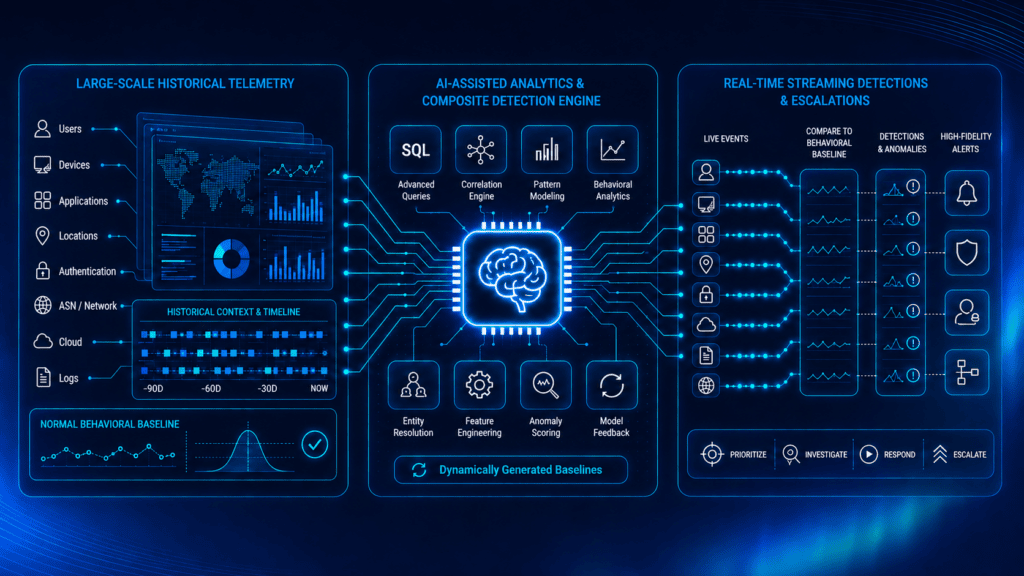
AI-assisted detection engineering becomes even more powerful when combined with composite detections built on large-scale historical telemetry. Unlike traditional detections that evaluate isolated events in short time windows, composite detections leverage historical context and behavioral analytics to identify activity that meaningfully deviates from normal patterns within customer environments.
In many cases, the challenge is not identifying whether an event is inherently suspicious in isolation, but determining whether the behavior is unusual for that specific user, device, application, network, or organization. Solving that problem requires baselining normal activity across large volumes of historical telemetry.
AI agents are increasingly helping detection engineers accelerate the development of these baseline analytics. By analyzing existing detections, telemetry schemas, historical investigations, and behavioral patterns, AI-assisted workflows can help engineers rapidly develop and refine the complex SQL and correlation logic required to model normal activity at scale. These baseline queries can identify patterns such as normal authentication locations, typical ASN usage, expected device behavior, common application access patterns, administrative activity, network communication trends, and other environment-specific behavioral norms.
Once validated, these analytics can then be operationalized directly into streaming detection pipelines, allowing the platform to evaluate incoming events against historical behavioral baselines in real time. Deviations from those learned patterns, particularly when combined with additional contextual enrichments and cross-event correlations, can then be escalated as high-fidelity detections.
This approach fundamentally changes how detections are developed and deployed. Rather than relying exclusively on static signatures or manually crafted rules, detection engineers can focus on understanding attacker tradecraft and defining meaningful behavioral patterns while AI accelerates the implementation and operationalization of the underlying analytics. The result is a more adaptive detection ecosystem capable of evolving alongside both customer environments and attacker behavior.
Identity Threat Detection and Response (ITDR)
A key example of composite detections and behavioral analytics in action is our new suite of Identity Threat Detection and Response (ITDR) detections. These detections represent a fundamental shift in how we identify compromised accounts and identity-based attacks across our customer environments.
What Are Identity Threats?
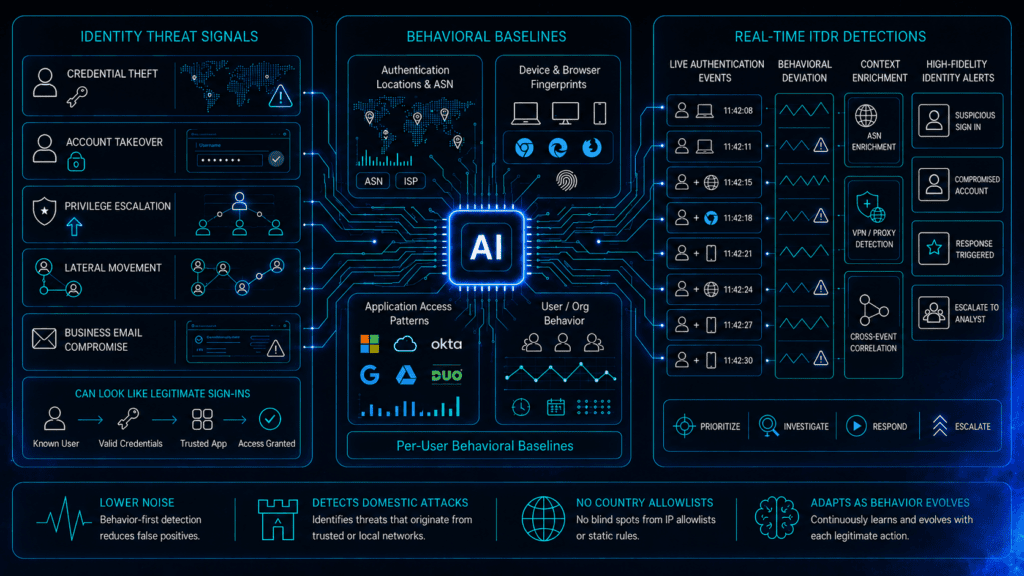
Identity threats are attacks that target user accounts, credentials, and authentication systems to gain unauthorized access to an organization’s environment. They include credential theft, account takeover, privilege escalation, lateral movement using stolen credentials, and business email compromise (BEC). Identity-based attacks represent the primary threat vector in modern cybersecurity – over 80% of breaches involve compromised credentials, and compromised identities are consistently one of the largest categories of confirmed malicious activity across the Arctic Wolf® Managed Detection and Response (MDR) customer base.
The challenge with detecting identity threats is that the malicious activity often looks identical to legitimate user behavior when evaluated in isolation. An attacker who has stolen valid credentials authenticates using the same mechanisms as the real user. What makes the activity suspicious is not the event itself, but how it deviates from the user’s normal behavioral patterns.
How ITDR Detections Work: Behavioral Baselines
Rather than relying on static rules or geographic allowlists, our ITDR detections are built on behavioral baselines derived from large-scale historical telemetry. These baselines model what normal authentication activity looks like for each user, device, application, and organization by analyzing patterns such as:
- Authentication locations and ASN usage: where users typically sign in from, including expected IP ranges and network providers
- Device and browser fingerprints: which devices, operating systems, and browsers a user normally authenticates with
- Application access patterns: which applications and resources a user regularly accesses
When incoming authentication events deviate meaningfully from these learned baselines, the platform evaluates the deviation in combination with additional contextual enrichments, such as ASN enrichment, VPN and proxy detection, and cross-event correlation, to determine whether the activity represents a genuine threat. This approach allows the system to detect compromised accounts, even in cases where attacker location alone would not be a reliable indicator.
New Detection Categories
AI-assisted detection engineering is also enabling the development of entirely new categories of detections built on platform-scale intelligence. One example is Herd Immunity detections, which leverage cross-tenant telemetry, historical investigations, and confirmed malicious activity observed across the broader platform to identify attacker infrastructure and behavioral patterns that would be difficult to recognize within a single isolated environment.
Developing these detections requires analyzing enormous volumes of historical authentication activity, infrastructure reuse patterns, and attacker behaviors across many organizations. AI-assisted workflows help accelerate the creation of the complex analytics and correlation logic required to operationalize these patterns into production detections. Detection engineers can focus on identifying meaningful behavioral relationships, such as shared attacker infrastructure, repeated authentication patterns, or cross-tenant device code phishing activity, while AI assists in generating and optimizing the underlying detection logic.
These detections can then be deployed directly into streaming pipelines where incoming activity is continuously evaluated against both customer-specific behavioral baselines and malicious patterns observed across the broader platform. The result is a more adaptive detection model capable of identifying threats that may appear ambiguous within a single tenant, but become high-confidence indicators of malicious activity when viewed across thousands of environments and investigations.
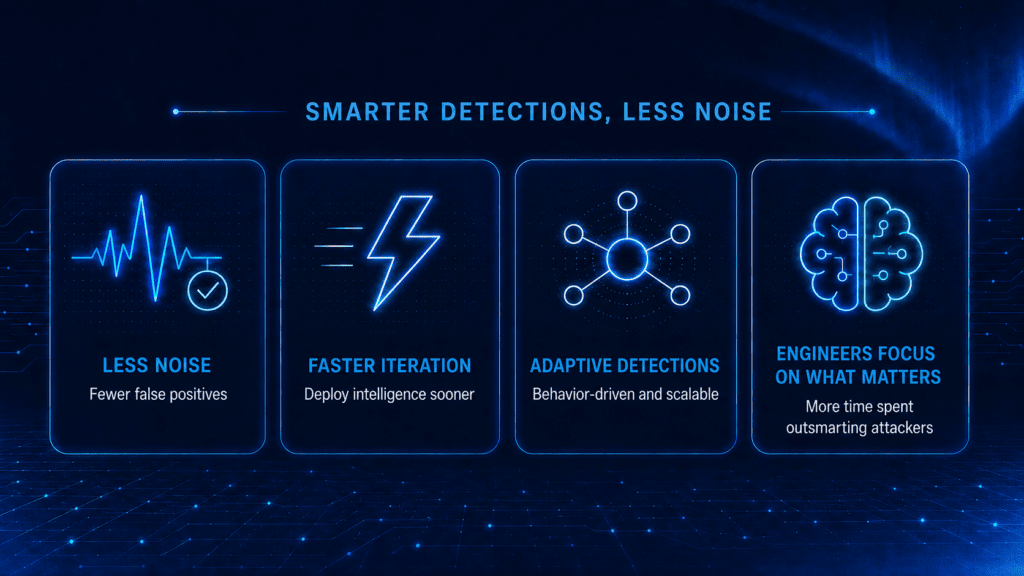
Smarter Detections, Less Noise
AI-assisted detection engineering is about removing the friction between understanding attacker behavior and operationalizing that understanding at scale.
Across every layer of the detection lifecycle, the pattern is the same: engineers bring the tradecraft expertise, threat intelligence, and investigative intuition. AI accelerates the implementation. Whether it is generating and optimizing SQL queries, building behavioral baselines from massive historical telemetry, developing composite detections that correlate activity across time and context, or operationalizing cross-tenant Herd Immunity patterns into streaming pipelines, AI handles the heavy lifting so engineers can focus on what actually matters: outsmarting attackers.
The shift is fundamental. Detection development moves from manual and rule-centric to fast, adaptive, and behavior-driven. Teams iterate faster as threats evolve, operationalize intelligence sooner, and maintain consistency across growing detection portfolios — all while spending less time wrestling with implementation details and more time doing the work that only human expertise can deliver.
Additional Arctic Wolf Resources:
- Arctic Wolf’s free Threat Intelligence newsletter: ThreatPulse Community Edition
- Read our latest blog on detecting identity attacks at scale via Herd Immunity
- Arctic Wolf Tech Den
- Arctic Wolf Blog
Legal Disclaimer: This blog may include forward‑looking statements. These reflect our current views and are subject to change. They are not guarantees, and actual results may vary. Images in this blog are provided for illustration purposes only, and do not depict or represent real Arctic Wolf consoles or product screenshots.