

Cut through the noise:
Find the Right Cybersecurity Solution for Your Business
Selecting the right cybersecurity solution is complex. Vendors often use similar terms for vastly different capabilities. This resource provides expert guidance to navigate your options, highlighting the strengths, limitations, and nuances of each solution.
Compare Security Technologies and Service Models
Explore our interactive comparison tool to understand which cybersecurity solution aligns best with your organization’s operational needs.
Filter by term

Endpoint Detection and Response (EDR)

Extended Detection and Response (XDR)

Security Information and Event Management (SIEM)
Definition
Endpoint Detection and Response (EDR)
EDR is often part of an endpoint protection platform (EPP), with capabilities that can block known and unknown threats as the first line of defense. EDR is designed to continuously monitor and respond to alerts on endpoints, including laptops, desktops, and servers to detect, investigate, and respond to suspicious activity.
Extended Detection and Response (XDR)
XDR extends the functions of EDR to unify telemetry, detection, and response across multiple attack surfaces, including endpoint, network, cloud, email, and identity. Vendor approaches vary, ranging from open platforms that support multiple attack surfaces to solutions that emphasize endpoint integration.
Security Information and Event Management (SIEM)
SIEM collects and analyzes log data from across an organization’s systems to identify anomalies, detect and respond to incidents, and support compliance. Most SIEMs act as centralized hubs for security visibility, feeding analytics that help teams prioritize and investigate threats.
Scope of Technology
EDR

EDR primarily leverages endpoint telemetry and threat intelligence to detect and mitigate endpoint-specific threats. It can contain limited coverage of other attack surfaces such as email, identity, or network.
XDR

*Vendor dependent
SIEM
SIEM offers threat detection across many attack surfaces and ingests various log data sources. It is vendor-dependent as to who onboards new log sources and whether tuning is included. Organizations may need at least one or more full-time engineers to manage and use the SIEM depending on the services agreed.
*Service model dependent
Technology Pros and Cons
EDR
-
Provides deep endpoint visibility
-
Detects and remediates endpoint-based threats quickly
-
Improves response time for security incidents
-
Limited visibility beyond endpoints
-
Generates a high volume of alerts
-
Focuses on detecting and responding to active threats only
XDR
-
Expands beyond endpoints
-
Enhances overall security posture by breaking down siloed tools
-
Scope varies between vendors
-
May require vendor lock-in for visibility or offers limited integrations
-
Enhanced visibility can increase alert fatigue
-
Certain solutions rely on a proprietary XDR stack from the vendor
SIEM
-
Centralizes log data across the enterprise for visibility, compliance, long-term storage, and historical analysis
-
Complex to deploy, maintain, and tune
-
Organizations must devote headcount to maintenance and operations
-
Correlation rules require ongoing effort with high licensing-and comsumption-based pricing
Related Service Offering
EDR
mEDR
When endpoint threats are detected, managed endpoint detection and response (mEDR) services use built-in tools to investigate and respond to alerts. Many MDR providers originated with endpoint-centric mEDR offerings, making it important to understand each vendor’s data coverage. When endpoint threats are detected, these services use built-in tools to investigate and respond.
XDR
mXDR
The most valuable managed XDR (mXDR) offerings deliver a turnkey experience, using open architectures that varies depending on the vendor’s design and integrations. These services, sometimes called MDR, analyze telemetry, provide recommended actions, and may perform active threat mitigation
SIEM
Managed SIEM
Managed SIEM services may be delivered as fully managed or co-managed options that handle data aggregation, correlation, and threat hunting. These offerings are typically operated by third-party providers such as MSSPs or systems integrators.
Managed Service Includes
EDR
Managed EDR services handle threat detection and initial mitigation for covered endpoints. They alert customers when a mitigation action occurs or additional input is required. These services typically provide 24×7 monitoring of endpoint alerts.
XDR
Managed XDR services vary by provider and underlying technology. Some operate similar to an MDR offering while others may have limited detection and response scope. Look out for those using third-party tools or reduced managed functionality such as not offering automated playbooks.
SIEM
Managed SIEM offerings are often more rigidly structured than other managed services, providing deployment, configuration, management, monitoring, and troubleshooting of the SIEM. Services often include alert tuning and enrichment or orchestration but may not always extend to alert investigation and response, which are sometimes added through SOC-as-a-Service options.
Common Considerations
EDR
mEDR’s scope is limited to endpoints. It provides little to no visibility into attacks originating from non-endpoint sources such as network, email, firewall, or cloud systems, and services offer minimal guidance on broader security posture.
XDR
mXDR is sometimes marketed interchangeably with MDR or SOC-as-a-Service. Vendors that also offer a SIEM or data lake component may classify MDR as mXDR, often requiring additional SKUs or integrations for full functionality. Even with these add-ons, XDR elements can remain limited in human-led monitoring, triage, and response.
SIEM
Managed SIEM often includes deployment, tuning, and maintenance of the platform along with 24×7 monitoring and threat detection coverage. Because SIEMs are often co-managed, they require significant in-house effort for ongoing tuning and rule creation. Platform and storage costs are usually separate from the managed service and may include licensing, ingest, data-retention, and storage-tier fees. Advanced SIEM use cases can add further cost beyond standard managed-service terms.
Shared Responsibilities for Managed Models
general guidelines, co-management varies by vendor*
- Vendor Manages
- Customer Manages
- Vendor Dependent
EDR
24x7 threat detection and mitigation
Perform response and containment
Ingestion across multiple telemetry sources
Proactive security hardening
Deployment services
Identify security gaps and show progress on risk mitigation
XDR
24x7 threat detection and mitigation
Perform response and containment
Ingestion across multiple telemetry sources
Proactive security hardening
Deployment services
Identify security gaps and show progress on risk mitigation
SIEM
24x7 threat detection and mitigation
Perform response and containment
Ingestion across multiple telemetry sources
Proactive security hardening
Deployment services
Identify security gaps and show progress on risk mitigation
Arctic Wolf is the Proactive, Outcome-Driven MDR Solution
Your security operations partner for MDR and beyond

Arctic Wolf AuroraTM Platform
Arctic Wolf’s Aurora Platform is the open-XDR foundation of our MDR solution. It collects telemetry from across your environment, including endpoint, network, identity, and cloud at one predictable price. It enriches and analyzes that telemetry using AI to rapidly detect threats and reduce alert fatigue. By delivering actionable insights instead of noise, we issue only one ticket per day on average for our typical customers.

The Concierge Experience powers proactive MDR. Our security experts step in to offer concrete hardening recommendations that strengthen your organization’s security posture. This human-plus-technology approach ensures we know what’s important to your business and work together to continually improve outcomes.

Largest Commercial SOC
With a Security Operations partner like Arctic Wolf, you get full scope through the Aurora Platform’s visibility and broad integrations, full support with 24×7 monitoring, expert triage, and response, and predictable pricing – backed by one of the world’s largest commercial SOCs processing 9+ trillion events weekly across 10,000+ global customers.
Detection and response is only part of the picture. Arctic Wolf delivers holistic security outcomes by combining industry-leading 24×7 detection and response with proactive security posture improvements—tailored to your specific risk goals. We don’t just respond to threats. We help you prevent them.
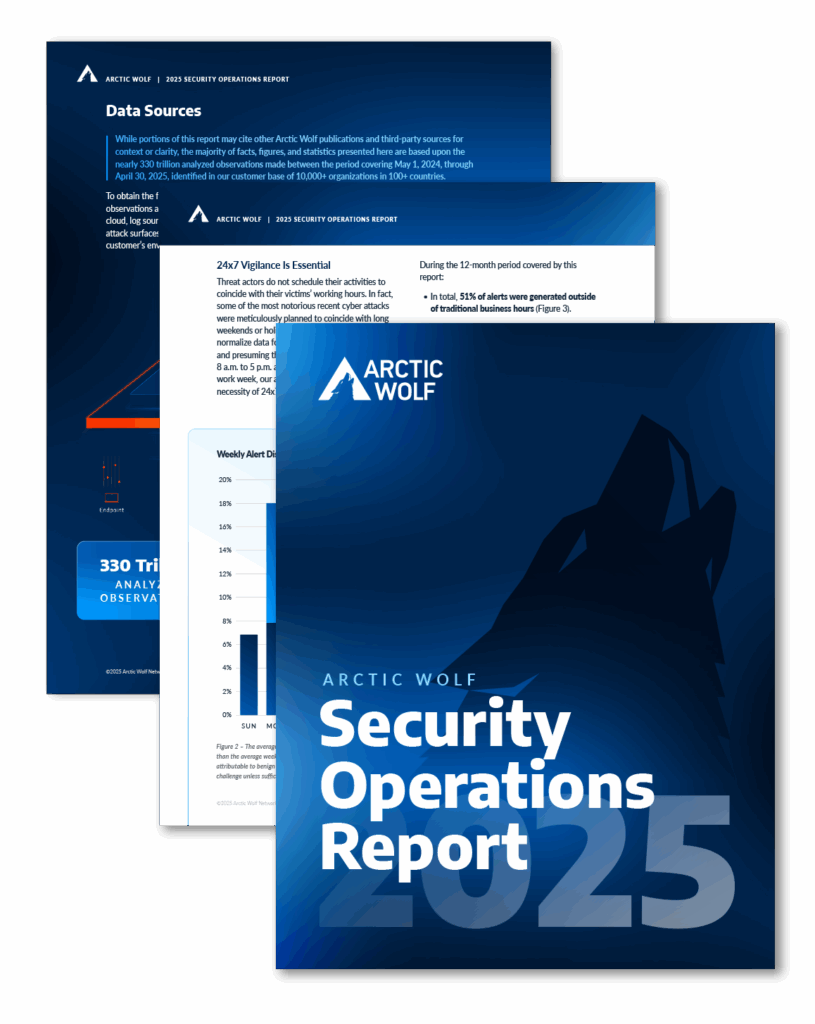
Arctic Wolf
Security Operations Report 2025
Cybersecurity is a whirlwind of constant change.
Learn how Arctic Wolf’s world-class SOC helps you close security gaps with 24x7 monitoring, context-rich triage that reduces alert fatigue, and rapid human-led response to contain threats faster.
Questions? Contact us today.
Our cybersecurity experts are ready to help. Reach out to schedule an introductory call with one of our team members and learn how an Arctic Wolf partnership can accelerate the growth of your security practice.
General Questions:
1-888-272-8429